Eteläkarjalainen maisema

Eteläkarjalainen maisema
Tässä blogissa on sekä kuvia että tarinoita upean Etelä-Karjalan luonnosta, ihmisistä ja kulttuurista. Kuvassa syyskuinen näkymä Saimaan kanavan varrelta.
Näytetään tekstit, joissa on tunniste newspaper. Näytä kaikki tekstit

torstai 12. tammikuuta 2017

Finnish Apostolic Lutheran Congregation in Calumet

Finnish Apostolic Lutheran church in Calumet in the beginning of 20th century.
The oldest Lutheran congregation founded by Finnish immigrants in the USA is Finnish Apostolic Lutheran Congregation in Calumet, Michigan. It was organized in 1872 and legalized next year with the name Solomon Kortiniemi Lutheran Society. The peculiar name is due to its first pastor. In the end of 1870's name was changed to the Finnish Apostolic Lutheran.  This congregation was the largest Finnish American Lutheran congregation in America from the 1870's to the 1890's. Lots of Finnish American history is hidden in church books and minutes of this congregation. But sadly, their archives are not open for researchers. I've tried to find other paths to examine this community.  I have found lots of congregational information in Calumet-based Amerikan Suomalainen Lehti. The majority of shareholders in this weekly Finnish newspaper were Apostolic Lutherans. The first fruits of this labor are now freely available for everyone interested. I've started with the year 1879. HERE you will find statistics compiled by me. It includes births, deaths, marriages and membership statistics.

Ps.
Years 1880, 1881 and 1882 are now completed. Links to those statistics are below.

Year (1880) is now completed and will be found HERE.

And the statistics for the year 1881 is now on THIS PAGE.

And for the year 1882 on THIS PAGE

And the year 1883 is now completed and is HERE

Some of the earliest documents of the Solomon Kortiniemi Lutheran Socitey are now scanned:

Articles of Association and in Certificate of Incorporation

List of founding members

Name changed to the Finnish Apostolic Lutheran Congregation in 1879


perjantai 2. joulukuuta 2016

Lehtinen - a short-lived Finnish American newspaper in 1876

I have previously written a post about first Finnish American newspaper,  Amerikan Suomalainen Lehti, which can be found here. There is also a separate article about the founder and editor of the newspaper, Anders J. Muikku

After Anders J. Muikku was forced to cease publication of Amerikan Suomalainen Lehti, he was soon again involved in the publication of a new Finnish newspaper in Copper Country. At least 11 issues of a small Finnish-language paper, which was given a very descriptive name: Lehtinen (Engl: flier/leaflet/small newspaper) were published in the autumn of 1876, between September and the beginning of November. Lehtinen was sponsored by local Republican businessmen, and it took strong political positions. It's most obvious mission was to agitate Finnish immigrants vote for Republican candidates in the upcoming elections. After the election Lehtinen ceased publication. It is said that Muikku edited this paper while he was in a local jail for some mischief.

I read through all the preserved Lehtinen issues. In Addition to the political opinions and propaganda the newspaper mainly contained  news from the United States and also some from the rest of the World. The share of Finland news, however, was almost non-existent. The activities of the local Finnish Evangelical Lutheran congregation was informed also impressively. Instead the paper was silent about the competing Finnish church, the Apostolic Lutheran Church and their activities.

tiistai 15. marraskuuta 2016

Letter from the Finnish American newspaper pioneer from Minnesota 10/02/1870


Finnish Cemetery near Franklin, Renveille County


The pioneer of the Finnish-American press, Alexander Leinonen sent his first writing to Oulun Wiikko Sanomat from Minnesota in early spring 1870. It was released on 04.02.1870. After this, he wrote using pseudonym "-der-nen" into the paper until the year 1876. I wrote this first letter down, so, here you go:

Oulun Wiikko Sanomia.
April 2, 1870
Sand Creek, Scott County, Minn, February 10, 1870
Dear, Mr writer!

Allowed by God, I have happily come America and visited here many States, staying as a railway laborer in cities and working at farms. The most populated part of the State of Minnesota, I've walked around in a criss-cross, so, especially the condition of the laborers, that is here, I think, the best on earth, I have come to know very well. At the beginning of the year, I came to this county, and I've been reading English at a school. For the coming summer I've got work as surveyor in a railway company.

Memoirs of my travels in Sweden and a fragmental description of my visit in the Finnish colony in Mooers Prairie, I will send here for the publication, so you can see if they are fit and worthy. In the same sense, I also send some information about immigration. If I have spoken, in that, at some point too hard/loud to the European ears, so I ask you humbly to eliminate such (words) out,  if you see the writing otherwise, it deserve the publicity. - Only after I've more settled down, I hope to send a larger set of information from America.

There are many more Finns in America than its thought in our homeland, but they are spread all over the United States. In Mooers Prairie [1], at Cokato Lake, there are twelve Finnish land owners, in Homes City area, a hundred miles west of Mooers Prairie, is said to be almost as many. In the third area, called Hort [2] in Minnesota, I've heard (talk) that there are also living some of our compatriots. Only a few have come here direct from Finland. Most have first moved to Finnmark, and from there here. Also, many Swedes, Finns from ancient colony in Wermland, which still are talking wonderful clear Finnish, have settled to the vicinity of the Finns. They have the same nature, among these compatriots, as which we have heard, is also in Ruija (Finnmark), that they keep their mother language, to show it here, too. Scandinavians like a lot of their Finnish neighbors and among yanks have our compatriots got excellent reputation. - Next summer, is expected to come here a lot of Finns from Finnmark, where livelihoods are said to getting worse and all the time.

What comes to America, so much correct is known in Europe about conditions here, but theres even more incorrect. For my part, Ive found here a lot more freedom than I dared to hope, and the local conditions I've seen a lot better when you dared to think of. - The more I come to know these conditions, the more I been satisfied in the belief that Europa has long enough been living without noticing benefits of a rational state and impact of religious freedom on its people.
Age, happiness and health!
Etc. respect.
-der-nen

[1]. Mooers Prairie 1862-1878 was the name of the post office. In 1878 the post office was organized city that adopted its name to Cokato. See. Minnesota Place Names: A Geographical Encyclopedia By Warren Upham, page 639.
[2] The Finns called this settlement for Hurtti. It was located near Franklin, in Renville County.

torstai 18. joulukuuta 2014

A. J. Muikku, the first Finnish newspaperman in America. (Updated November 21st, 2016)


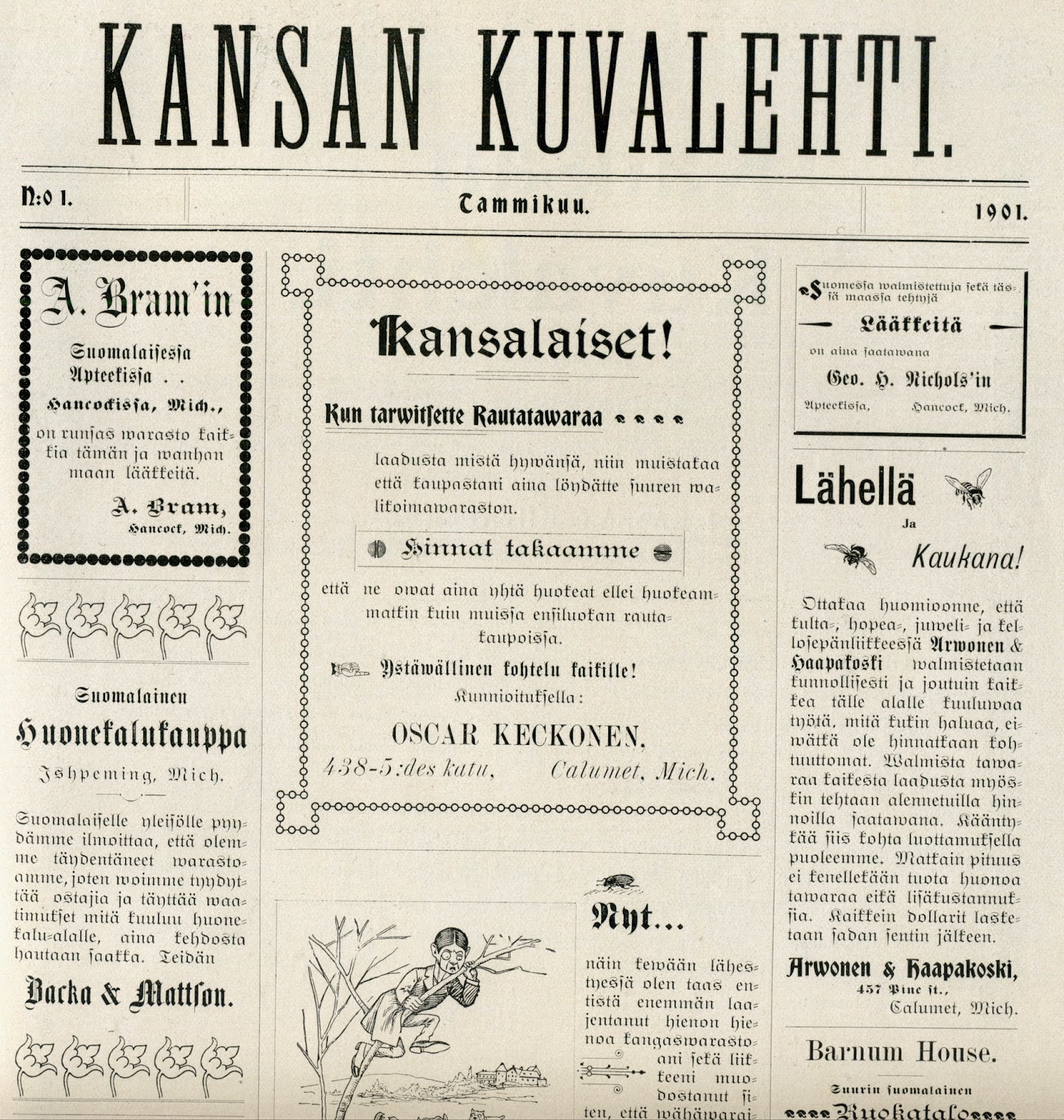
Kansan Kuvalehti was published monthly in Hancock, Michigan 1901 - 1903
I picked the following article in the Kansan Kuvalehti (People's Pictorial), which was published in Hancock, Michigan in 1901 - 1903 (1/1901). The same paper also had a picture (see below) taken at A.J. Muikku's grave during the time when a memorial stone was erected.

-------
A. J. Muikku's gravestone at the Quincy Hill Cemetery in Hancock in 1880


A. J. Muikku, the first Finnish newspaperman in America.

Finnish newspapers are not very old (in America). Only about twenty four years has passed since the first Finnish newspaper began to appear in Hancock, Michigan, edited by A. J. Muikku.

A. J. Muikku was the son of painter from the town of Joensuu. He had attended school and matriculated, but if he had continued his studies or not, is not known. Since then, he worked for an observatory in St. Petersburg, Russia, as a counter, but was forced out and came to Copper Country in winter 1876. He started to plan a (Finnish) newspaper and received to some extent support of local Evangelical Lutherans. The project became a reality and Amerikan Suomalainen Lehti (Finnish-American Newspaper) was published in the spring of 1876 during the Philadelphia World Exhibition. In the paper there were many pictures taken at the Exhibition. This effort wasn't however long-lasting. Only twelve issues were published, as well as half of one issue at the expense of mr Bäckström who still tried to assist. Muikku himself was sent to Houghton prison because of trick. There he edited few issues of a small leaflet (Lehtinen), which some lawyers supported during a election dispute. In winter 1876, he fell ill at a Finnish (immigrant's) home on Quincy Hill , and there he also died.

In the spring of 1879 some Finns went one Sunday morning to Hancock's Cemetery take a look at Muikku's tomb. As a result this was organized a collection for the acquisition of a gravestone. Our photograph (above) shows Muikku's tomb decorated with wreaths.

A. J. Muikku's ways of life do not deserve a special commemoration, for he had had somewhat bad traces. But we must think and remember him as a founder of the Finnish newspaper business.

 ----

Post sriptum, November 21st, 2016

I found more information in articles below (Amerikan Suomalainen Lehti, 1880). Anders J. Muikku' headstone was erected on Fourth of July in 1880. The money for it was collected by Erik Pikkarainen and Johan A. Alanenpää. Aleksander Leinonen, editor-in-chief in Amerikan Suomalainen Lehti,
was responsible for the project which cost about $ 25. His paper also published project's account summary and list of donations. So, you can see, if among them are some of your ancestors.
Amerikan Suomalainen Lehti 05/07/1880


As readers will recall, so last fall was already collected $ 15 for the purchase of the headstone for deceased high school graduate  A. J. Muikku, who is remembered as the founder of the Finnish American press.Ten dollars more is still required to this need, and if someone would want to fill it up with a little, voluntary gift, so they will be accepted with gratitude by Erik Pikkarainen and the editor of this newspaper. It has been decided to erect the headstone with a suitable celebration on the next Fourth of July.


Amerikan Suomalainen Lehti 07/23/1880

Account summary


The following persons donated money for the headstone of deceased high school graduate A. J. Muikku:
  Nils Majhannu 25c, Johan A. Alanenpää 50c, Frans o. Salmonson 25c, Petter Kerttu 25c, Peter A. Christopher 25c, Matts Peteri 50c, Johan H. Joki 25c, Johan Anttihilli 25c, Isak Hirvaskari 15c, Andrew Johanson 25c, Erik U. Närä 25c, Isak Sandqvist 50c, Henrik Aho 10c, Peter Lustig 25c, Henrik Johanson 10c, J.W.Sjöberg 50c, Peter Frisk 10c, Salmon A. Alanenpää 15c, Isak Bäckström 50c, Isak Anderson 50c, Karl Martimo 25c, Matts Hiltunen 10c, Johan Frisk 50c, Daniel Halonen 1 markka, Johan Takkinen  $ 1.00; Karl Teppo 75c, Peter Oström 50c, Stefan Olson Hill 75c, J.P.Johanson $ 1.00, A.E.Backman 25c, J.M.Wintori 25c, J.M.Holappa 5c, Olof Halonen 50c, B.O.Bäckström 20c, Peter Mark 25c, Johan Anttila 25c, Arvid Pitkänen 25c, M.H.Larson 50c, David Castrén 20c, A. Nylund 25c, J. Peterson 10c, S.Lustig 10c, F.P. 10c, H.H. 20c, Pe. Pikkarainen $ 1.00, Johan Eckrea $ 1.00, J.H.Ström 10c, J.T. 5c, Johan Österberg 25c, A.S. 5c, Karl A. Peltoniemi 25c, T.Strömberg 25c, Oscar Marttila 25c, Erik Pikkarainen 60c, Jaako Ojanperä 50c, Anders Matinlauri 50c, Peter B. Henrikson 50c, A(lexander) L(einonen) $ 1.60


Because the acquisition of the headstone has been my worry on, so I can now publicly recite my heartfelt thanks to all gift givers. Special thanks go to Erik Pikkarainen and Johan A. Alanenpää, who have taken care of these donations.
Alex. Leinonen

perjantai 7. marraskuuta 2014

Finnish Newspapers in America, part three: Sankarin Maine


As we read earlier, had  Matts Fredd moved Sven Tuuva from Houghton to Hancock in October, 1878. In the beginning of next year he also changed  the name of his paper to Sankarin Maine = The Fame of a Hero. The very last copy of  Sven Tuuva was published on January 3, 1879. And the first copy of Sankarin Maine was delivered seven days later, on January 10, 1879. The paper was larger in size than it had been with Sven Tuuva.

The life of Sankarin Maine was also quite short. The paper's slogan was now "Long live Sankarin Maine". The content of Sankarin Maine was colourful but diversified. The editor tried  to keep readers up-to-date on world news and on matters affecting the Finns on the Copper Country. The hard and colourful competition between Fredd's Sankarin Maine and Aleksander Leinonen's Amerikan Suomalainen Lehti forced Fredd stop publishing his paper in April, 1881. After the closing Matts Fredd returned to his painting and decorating business.

maanantai 27. lokakuuta 2014

Finnish Newspapers in America, part two: Sven Tuuva


The life of Amerikan Suomalainen Lehti was quite short. Next effort started year and a half later. This paper  - Sven Tuuva -was first published in Houghton and moved later to Hancock.

Sven Tuuva
(or Swen Tuuwa) began publishing on Jan. 4, 1878 by Matti Fredd. Matti or Matts Fredd was born in Vaasa (Ilmonen writes in Amerikan Suomalaisten sivistyshistoria on page 22 that he was born in Kokkola). His native language was actually Swedish, so he studied at the local Swedish elementary school.  Later he learned to be a professional painter. As a journeyman painter he traveled to Turku, St Petersburg in Russia and Sweden. According to Ilmonen he moved to Kuivaniemi, which belongs to a Finnish speaking area. There he learned speak and write some Finnish. Holmio (p. 368) writes it happened in Oulu. He received his master's papers in Raahe

Matts Fredd moved to America in 1871 and started his own painting and decorating business in Hancock in 1876. Finnish immigrants flooded to Copper Country mines in big numbers at that time. When the need for a Finnish newspaper was increasing, Matts Fredd decided to meet the demand.

The first paper came out on January 4, 1878. It was a small three-column paper with motto: Sinulle Suomalainen puhun sanan harvaan vainen / To you, Finn, I say just a few words. On October 1878 it was moved to Hancock and in the beginning of next year Fredd changed its title to Sankarin Maine. Some opposition developed to Fredd's paper. It was caused by his outspoken way of writing. Fredd called his opposition with the word "league".