Eteläkarjalainen maisema

Eteläkarjalainen maisema
Tässä blogissa on sekä kuvia että tarinoita upean Etelä-Karjalan luonnosta, ihmisistä ja kulttuurista. Kuvassa syyskuinen näkymä Saimaan kanavan varrelta.
Näytetään tekstit, joissa on tunniste Finnish American. Näytä kaikki tekstit

sunnuntai 12. maaliskuuta 2017

Winter War, the Finnish Relief Fund and the Midwestern town of Lead, South Dakota


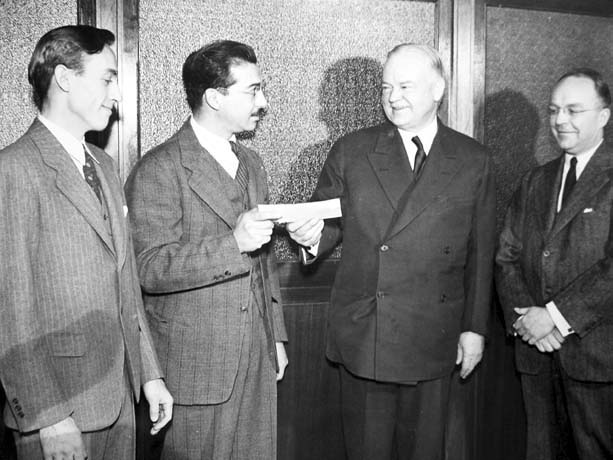
Well-known artist Jon Corbino presenting a check to former President Herbert Hoover for the Hoover Committee for Finnish Relief 1940. Photo sourced from http://leecorbinogalleries.com/Daddy&Hoover.jpg
Lead Daily Call, January 25, 1940
Tomorrow, on 13th March, 2017, 77 years have passed since the end of the Winter War. Almost everywhere a small countrys battle against the much larger aggressor aroused compassion and plenty of volunteer activities. This happened also all over in the USA. Most active were, of course, Finnish Americans and people with other Scandinavian background. The Finns, however, were supported in every level in the U.S. society. There was only one exception, Communists.

 Lead Daily Call, January 29, 1940
A number of organizations were created in the USA to help the Finns. The most significant of them was The Finnish Relief Fund. It was a humanitarian aid organization initiated by former United States President Herbert Hoover in December 1939, after Soviet Union had invaded Finland on 30th November, 1939. The war ended with the Moscow Peace Treaty on 13th  March, 1940. The League of Nations deemed the attack
The local Finnish Sauna supported Finnish Relief Fund, too.
Lead Daily Call, December 13, 1939
illegal and expelled the Soviet Union from the League on 14 December 1939. The Soviet Union had intended to conquer all of Finland and established a puppet Finnish Communist government in Terijoki, Carelia.  Despite of the fact, that the Soviets possessed more than three times as many soldiers as the Finns, thirty times as many aircraft, and a hundred times as many tanks, they failed. 

President Herbert Hoover himself wrote later, how his initiative started (An American Epic, Volume IV)
 Lead Daily Call, January 10, 1940

-----
On December 3, the Finnish Minister to the United States, Hjalmar J. Procope, through my old associate, Lewis L. Strauss, asked if our group would undertake to organize relief for Finland as we were already doing for Poland. Before replying, I again, as in the case of Poland, urged Norman Davis, Chairman of the American Red Cross, that this relief be undertaken by that organization. I proposed that our group would serve under him if he wished. He decided the Red Cross would limit its services to medical aid and would collect garments through its chapters. However, Finland's most critical need was food.

Lead daily Call, January 10, 1940
Our old colleagues incorporated the Finnish Relief Fund, Inc., under the laws of Delaware on December 6, 1939. Except for part of the clerical help, this American organization consisted entirely of volunteers. The following officers were elected: Herbert Hoover, Chairman; Edgar Richard, President; Lewis L. Strauss, Vice-President; John Jay Hopkins, Vice-Chairman and Director of Organization. Additional Directors: Perrin C. Galpin, Frank C. Page, Raymond Sawtelle, Edwin P. Shattuck, John L. Simpson, H. Alexander Smith, Clare M. Torrey...

On December 7, I made the following address on Finnish relief:
Lead Daily Call, March 25, 1940
Lead Daily Call, December 18, 1939
America has a duty to do its part in the relief of the hideous suffering of the Finnish people. Our people should have an outlet in which to express their individual and practical sympathy. I have consented to organize a nation-wide Finnish Relief Fund for this purpose. I appeal to the American people for its support. Finland is not a rich country. The people have little reserve for emergency. They are making a heroic defense. Air attacks have compelled the evacuation of civilians from their towns and cities. Hundreds of thousands of women and children have been driven from their homes in the middle of northern winter...Others are without adequate shelter, clothing, and food. This Fund is for the purpose of serving these broad needs. The American Red Cross has appealed for funds to furnish medicines, hospital supplies, and many garments will be provided through their chapters. They should be supported. The two funds will cooperate fully...
-----
By March 1940, The Finnish Relief Fund had raised 2.5 million US dollars. Altogether the sum was over 3,5 million dollars.
President Hoover sent a telegram to the publishers of America's leading newspapers, asking whether they would receive contributions, report the donors in their columns, and remit the money to the Relief Fund. Hoover's campaign was advertised in 1,400 newspapers across the United States. The largest contributions came from private donors ($1.9 million), newspaper ads ($652,869), industrial companies ($318,188) and labor unions ($27,294).

The Finnish Relief Fund was very active in the Black Hills area, too. The local newspaper, Lead Daily Call, gave plenty of column inches to Relief Funds notifications, events and collections. The City of Lead in South Dakota, were a few hundred Finns
Lead Daily Call, January 30, 1940
lived, proclaimed a Finnish Relief Fund week in December. In the end of January, 1940, Lead had contributed already $2402 to the Finnish Relief Fund.


I gathered the attached newspaper clippings to find out how this small Midwestern town supported the Finns in their battle against overwhelming aggressor.


perjantai 2. joulukuuta 2016

Lehtinen - a short-lived Finnish American newspaper in 1876

I have previously written a post about first Finnish American newspaper,  Amerikan Suomalainen Lehti, which can be found here. There is also a separate article about the founder and editor of the newspaper, Anders J. Muikku

After Anders J. Muikku was forced to cease publication of Amerikan Suomalainen Lehti, he was soon again involved in the publication of a new Finnish newspaper in Copper Country. At least 11 issues of a small Finnish-language paper, which was given a very descriptive name: Lehtinen (Engl: flier/leaflet/small newspaper) were published in the autumn of 1876, between September and the beginning of November. Lehtinen was sponsored by local Republican businessmen, and it took strong political positions. It's most obvious mission was to agitate Finnish immigrants vote for Republican candidates in the upcoming elections. After the election Lehtinen ceased publication. It is said that Muikku edited this paper while he was in a local jail for some mischief.

I read through all the preserved Lehtinen issues. In Addition to the political opinions and propaganda the newspaper mainly contained  news from the United States and also some from the rest of the World. The share of Finland news, however, was almost non-existent. The activities of the local Finnish Evangelical Lutheran congregation was informed also impressively. Instead the paper was silent about the competing Finnish church, the Apostolic Lutheran Church and their activities.

keskiviikko 30. marraskuuta 2016

The first Finns in Fort Bragg (California) area

Former Finnish Temperance Hall in Fort Bragg
In my past writings I have already dealt with the Finnish Americans and organizations they established in Fort Bragg, in the Northwestern part of California. You can find them here, here and here. In the 1920s and 1930s, Reverend Salomon Ilmonen, who lived his late years in Fort Bragg,  wrote a number of books, which described Finnish Americans and their activities. However, it seems that he have not been enclosed Amerikan Suomalainen Lehti / American Finnish Paper's article 02/13/1880. It gives information about the very first Finnish Pioneers in the region, as well as their wealth. The majority of Finns were working at logging camps and sawmills, but some of them had settled down also as farmers. The article states that the first Finn permanently moved to the region as early as 1869 and others in 1877. So, it can be useful to bring this one article out of obscurity in the history:
Giant redwoods north of Fort Bragg

Noyo, Mendocino Co., California, in January 1880.
Now I get a possibility to give information about this warm summerland, that the winter has been very soggy, but now there is hope that the rain is over and once again become a quite warm summer. Here, the air is very fresh and healthy, and the mortality is very low. I will also mention something about our citizens around here. We are seven young men at this place, who have their own redwood "claims", which currently employs over a hundred Finns. Here you could still get properties in a very appropriate place using the Homestead Law, but the Finns did not much want to become landlords, which is due to the fact that they are so greedy for earnings and in love with money.

Here you can find a lot of work on the sawmills and logging work, which will be paid around  $40 - 45 in a month, food included. Land owner's position is here extremely good because they can keep how many animals they only want. You do not need to acquire shelters for them, because they live outdoors summers and winters. wheat isn't sown here in a big quantity, but instead barley, oats and especially potato and all types of vegetables.


Obituary of Matts Toppila in Amerikan Suomalainen Lehti 12/3/1880
Deceased
My tenderly beloved husband Matts Toppila fell into peaceful sleep of death
after a long disease, in Noyo. Mendocino Co, California, in
November 2, 1880, after living 42 years, which is hereby relatives and
friends
expressed.
Also, I get a possibility to give a little information about a few of the Finnish residents who have settled nowadays here and live about three English miles from Noyo. Their houses are in a beautiful location, at the coastal highway. The earliest [Finnish pioneer] resident was settled here as early as in 1869, the others not until in 1877. Their financial situation can be seen from the following:

Matts Toppila 115 acres of land, 2 people, 2 horses, 2 cows, 8 hogs, his entire fortune is valued at  $2800 .

Petter Johansson has 125 acres, 5 people
, 2 horses, 1 ox, 2 cows, 16 hogs, and his entire fortune is valued at  $3000.

Elias Johanson has 380 acres of land, 1 people, 4 horses, 12 cows
, 25 sheep, 30 hogs,
his entire fortune is valued at  $15000

August Jernberg has
40 acres of land, 1 people, 1 cow, 2 oxes, his entire fortune is valued at  $500.


Jacob Kesti has
150 acres of land, 2 people, 3 horses, 1 ox, 2 cows, 30 hogs, his entire fortune is valued at  $3500.


Jakob Hyman has 160 acres of land, 1 people, 2 horses, 2 cows, 18 hogs, his entire fortune is valued at  $ 3000.

One reader of the Amerikan Suomalainen Lehti

lauantai 26. marraskuuta 2016

" "Find My Family" in the 1880s


Over the years I have photographed all the saved and microfilmed issues of American Finnish Paper. Yes, I have had some authentic issues in my hands, but they are so old and in a bad shape that they will fall apart in hands. Those old issues will be/ have been the impetus for many of my blog posts. In almost every issue of The American Finnish Paper there were a number of notifications, in which relatives living either in Europe or in America  were looking for loved ones who had disappeared in the huge American continent. If the American address of relative was not known, the newspapers were almost the only opportunity to get access to the emigrant relative. The newspaper was an 1880s substitute for a currently popular Finnish TV-series "Kadonneen jäljillä" (Find My Family/1-800-Missing). As an example I picked the attached notifications, which were in the American Finnish Paper, issue 32, 08/06/1880. Similar notifications were, of course, in "the old country's" press, but in the American Finnish Paper their share was strikingly abundant.

Notifications on left in English:
-------
Information wanted.
If a sea captain from New York, which have a Finnish name Johan Häikiö, originally from Muhos, sometimes happens to find these columns, so he is requested to notify his address, either in American Finnish Paper or to the laborer's wife Margaretha Lantto (nee Määttä) in Alkkula, Ylitornio.
------
If Nils Lehto from Tornio, sometimes happens to find these lines, so he is requested with kindness to notify his place of residence to his brother-in-law, whose address is:
Jakob Penttilä
Negaunee P.P.
Marquette Co, Michigan

------
If Anders Rito sometimes happens to find these lines, so he is requested with kindness to notify his place of residence to the signer below,
Olli Kestilä
New York Mills P.O.
Otter Tail Co, Minnesota

----
If Matts Brandt, originally from Viitasaari, who has already been in America for 30 years sometimes happens to find these lines, 
he is requested with kindness to notify his place of residence to his
nephew, whose address is
Anders Brandt
Allouez P.O. Keweenaw Co. Michigan

torstai 24. marraskuuta 2016

A letter from Rocklin, California, January 20, 1880


Finnish Temperance Hall in October rain in Rocklin California

When I've traveled around many places where Finnsh immigrants settled down in America, I have visited California twice. In the late 1800s six "nesting places" for Finnish immigrants formed in this state: San Francisco, Berkeley, Reedley, Rocklin, Fort Bragg and Eureka. Of these, I have visited all but Eureka. The city of Rocklin been my destination twice. When visiting first time, the sun was shining on clear blue sky in the heat of June, during the latter visit the cold October rain whipped me. That rain was certainly a heavenly gift to local residents and the entire state affected by a long-lasting drought. The Finnish immigrants owned several stone quarries in Rocklin. Many of them were successful, and rose to the top positions in Rocklin city administration. My intention is to write a number of blog posts about the Rocklin Finnish community. I will start with the very first article I have found Finnish American Press. It was in the American Finnish Paper (Amerikan Suomalainen Lehti) 02/06/1880. Here you go:

Rocklin, California, January 20, 1880

Amerikan Suomalainen Lehti 02/06/1880


My desire would be to say a word about this small workplace for Finns, because you have not yet seen anything written from here before on Amerikan Suomalainen Lehti's columns. Here is the stone quarry work, in which the Finns have had the courage to start to try their luck. Here are four Finnish quarry employers, some to a larger, some to a lesser quantity. In this place, we are about 20 Finnish people, some of which have been enjoying their good health, but a few have been plagued by fever. I cant be without mentioning the beauty of this winter here in the western part of the country. Although this is the middle of winter, it is so beautiful weather, I've never seen a comparable, though I have spent the winter in many places in the United States. The snow has not been reflected at all, and will hardly be seen during the whole winter. At Christmas time, there were a few mornings a little bit rime, and the ground was a little bit frozen, but before noon it was already completely molten. It is amazing when it does not rain much water, but sometimes just a result of a great miracle. Around this time, the thermometer has showed about 60 notches in the shade. I wish nothing else but good luck and success to Amerikan Suomalainen Lehti and its readers.


Fred Fall