Eteläkarjalainen maisema

Eteläkarjalainen maisema
Tässä blogissa on sekä kuvia että tarinoita upean Etelä-Karjalan luonnosta, ihmisistä ja kulttuurista. Kuvassa syyskuinen näkymä Saimaan kanavan varrelta.
Näytetään tekstit, joissa on tunniste Black Hills. Näytä kaikki tekstit

sunnuntai 12. maaliskuuta 2017

Winter War, the Finnish Relief Fund and the Midwestern town of Lead, South Dakota


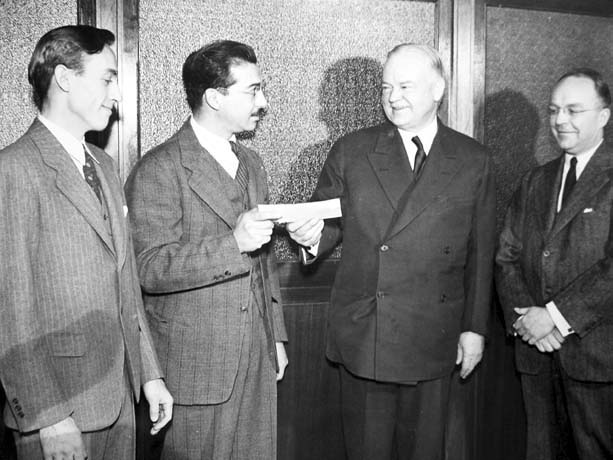
Well-known artist Jon Corbino presenting a check to former President Herbert Hoover for the Hoover Committee for Finnish Relief 1940. Photo sourced from http://leecorbinogalleries.com/Daddy&Hoover.jpg
Lead Daily Call, January 25, 1940
Tomorrow, on 13th March, 2017, 77 years have passed since the end of the Winter War. Almost everywhere a small countrys battle against the much larger aggressor aroused compassion and plenty of volunteer activities. This happened also all over in the USA. Most active were, of course, Finnish Americans and people with other Scandinavian background. The Finns, however, were supported in every level in the U.S. society. There was only one exception, Communists.

 Lead Daily Call, January 29, 1940
A number of organizations were created in the USA to help the Finns. The most significant of them was The Finnish Relief Fund. It was a humanitarian aid organization initiated by former United States President Herbert Hoover in December 1939, after Soviet Union had invaded Finland on 30th November, 1939. The war ended with the Moscow Peace Treaty on 13th  March, 1940. The League of Nations deemed the attack
The local Finnish Sauna supported Finnish Relief Fund, too.
Lead Daily Call, December 13, 1939
illegal and expelled the Soviet Union from the League on 14 December 1939. The Soviet Union had intended to conquer all of Finland and established a puppet Finnish Communist government in Terijoki, Carelia.  Despite of the fact, that the Soviets possessed more than three times as many soldiers as the Finns, thirty times as many aircraft, and a hundred times as many tanks, they failed. 

President Herbert Hoover himself wrote later, how his initiative started (An American Epic, Volume IV)
 Lead Daily Call, January 10, 1940

-----
On December 3, the Finnish Minister to the United States, Hjalmar J. Procope, through my old associate, Lewis L. Strauss, asked if our group would undertake to organize relief for Finland as we were already doing for Poland. Before replying, I again, as in the case of Poland, urged Norman Davis, Chairman of the American Red Cross, that this relief be undertaken by that organization. I proposed that our group would serve under him if he wished. He decided the Red Cross would limit its services to medical aid and would collect garments through its chapters. However, Finland's most critical need was food.

Lead daily Call, January 10, 1940
Our old colleagues incorporated the Finnish Relief Fund, Inc., under the laws of Delaware on December 6, 1939. Except for part of the clerical help, this American organization consisted entirely of volunteers. The following officers were elected: Herbert Hoover, Chairman; Edgar Richard, President; Lewis L. Strauss, Vice-President; John Jay Hopkins, Vice-Chairman and Director of Organization. Additional Directors: Perrin C. Galpin, Frank C. Page, Raymond Sawtelle, Edwin P. Shattuck, John L. Simpson, H. Alexander Smith, Clare M. Torrey...

On December 7, I made the following address on Finnish relief:
Lead Daily Call, March 25, 1940
Lead Daily Call, December 18, 1939
America has a duty to do its part in the relief of the hideous suffering of the Finnish people. Our people should have an outlet in which to express their individual and practical sympathy. I have consented to organize a nation-wide Finnish Relief Fund for this purpose. I appeal to the American people for its support. Finland is not a rich country. The people have little reserve for emergency. They are making a heroic defense. Air attacks have compelled the evacuation of civilians from their towns and cities. Hundreds of thousands of women and children have been driven from their homes in the middle of northern winter...Others are without adequate shelter, clothing, and food. This Fund is for the purpose of serving these broad needs. The American Red Cross has appealed for funds to furnish medicines, hospital supplies, and many garments will be provided through their chapters. They should be supported. The two funds will cooperate fully...
-----
By March 1940, The Finnish Relief Fund had raised 2.5 million US dollars. Altogether the sum was over 3,5 million dollars.
President Hoover sent a telegram to the publishers of America's leading newspapers, asking whether they would receive contributions, report the donors in their columns, and remit the money to the Relief Fund. Hoover's campaign was advertised in 1,400 newspapers across the United States. The largest contributions came from private donors ($1.9 million), newspaper ads ($652,869), industrial companies ($318,188) and labor unions ($27,294).

The Finnish Relief Fund was very active in the Black Hills area, too. The local newspaper, Lead Daily Call, gave plenty of column inches to Relief Funds notifications, events and collections. The City of Lead in South Dakota, were a few hundred Finns
Lead Daily Call, January 30, 1940
lived, proclaimed a Finnish Relief Fund week in December. In the end of January, 1940, Lead had contributed already $2402 to the Finnish Relief Fund.


I gathered the attached newspaper clippings to find out how this small Midwestern town supported the Finns in their battle against overwhelming aggressor.


sunnuntai 5. maaliskuuta 2017

History of a demolished Finn Church in Lead, South Dakota

The Black Hills Weekly, June 9, 1971

This is a story of now demolished Finnish church and defunct congregation in Lead, Black Hills, South Dakota. I have written one article about this congregation and Snoma Cemetery some years ago. I have got new information for this short article from the local newspapers and in Calumet, Mich., published Amerikan Suomalainen Lehti (American Finnish Journal). I have also got some copies of congregation's church books. The main source has been an article in Black Hills Weekly, June 9, 1971. 
----
The old Finnish Apostolic Lutheran Church, whose history was nearly as old as the town of Lead itself, was planned to be razed (in June 1971) to provide additional parking area for the visitors to the Black Hills, who tour the surface workings of the Homestake mine.
Births in the Lead Apostolic Lutheran Congregation,
Amerikan Suomalainen Lehti 05/30/1888

Located just above the Homestake tour guide house on Mill Street, the white wooden church was situated on Homestake ground and through the years has been the recipient of assistance from the mining company for its maintenance. Although extremely active during the years when a good percentage of the citys population was Finnish, the churchs congregation was gradually dwindled through the years until it could no longer afford to support a resident minister but depended upon visiting clergymen or laymen preachers. No services had been held in the church for the past year (1970). Although the church was not first incorporated until February 14, 1898, the congregation converted a log school house in the Washington addition of Lead for its services. Located on McCloud Street, the building was purchased June 18, 1888 from an L.R. Graves. But even earlier in 1887, was recorded the first birth in the congregation. In Amerikan Suomalainen Lehti (American Finnish Journal) the first congregational information related to the Apostolic Lutheran church in Lead was in May, 1888. It was given by Reverend Nels Pietila.
Layman preacher Matt Rivinoja's and his wife's
headstone at Hope Cemtery, in Newell, SD.

Signing the first incorporation papers were Henry Kirkila/Kiekila/Kickala. I. D. Pilda, Jacob Ojala, Gust Abramson and Jacob Korpela. The first records of minutes were dated February 4, 1895

The first pastor hired by the congregation was a Rev. Henry Jankala and some of the members names in 1898 included Matt Larson, Benjamin Hastie, Abe Lehto, Isaac Jeremiason, John Hikkela (Heikkila?), Sackari Seppala, Abner Kivijarvi, Aate Pelto, William Johnson, Fred Kangas, Lars Jacobson, Matt Rautio, Auti (Antti?) Tahti, Henry Buskala, Gust Abramson and Fred Niemonen. The secretary was Matt Larson and presiding trustee, Benjamin Hastie.[1]

The Mill Street church building was purchased from Mr. and Mrs Maurice Walsh of Spearfish for $3000 in January, 1909, and was formerly a store. Trustees at that time were Benjamin Hastie, Frank Anderson and John H. Frimodig. Pastor Nels Pietila was the pastor from around 1902 until his death in 1927.[2] He married, baptized and confirmed many members of families in the area. Birth records show names of towns, which like many of their residents are no longer alive, such as Perry, Brownsville, Horse Creek and Snoma. The services were all conducted in Finnish. Members of early-day congregation recalled that Pastor Pietila wore a beard and was a saintly-appearing man. He held the respect of the youngest Sunday School pupil to the oldest members.
Layman preacher Matt Aijala

Matt Rivinoja, a shoemaker by trade, served as a layman preacher until his death in 1932 and from then on the congregation secured visiting ministers and missionaries whenever they were available.  Rivinoja lived in Newell. Two other members served congregation as lay preachers, at times, in addition to Pietila and Rivinoja. They were Benjamin Hastie and Charles Aarni. The Rev. Raymond Tulkki of Michigan served as pastor years 1941 1942. He was followed by Matt Aijala, layman preacher, who came from Moose Lake, Minnesota. He served until his death in 1961.
Pastors from neighboring states held services, for several years, often in private homes as the congregation became smaller and smaller with the passing of older families. Some of these included Benjamin Hastie, John H. Frimodig, Charles Aarni, Andrew Autio, Isaac Fors, Konola, Rantanen, Kermu, Ahonen and Lagg familes. The congregation filed for incorporation March 26, 1948, after its first 50-year charter expired. A group of five Lead residents obtained incorporation papers. They were William Rautio, John Harju, Lempi Kormu, Fannie Lomheim and Mary Jacobson.


[1] In Amerikan Suomalainen Lehti appears also following names: William Wuopio, Isak Fardig, Henry Hiltunen, Matti Ojala, Johan Koskela, Abram Kiwijarwi, Esaias Pekkala, Johan Fredrik Niemi, Isak Kermu, Henrik Haka, Kalle Perttula, Kustu Ojala, Abram Luukkonen


[2] Nels Pietila was lay preacher/pastor in the congregation already from the year 1886.